
Born From Stardust (The Swing)
Born From Stardust (The Swing)
Oil on Canvas
36×48” 2025
Gallery Style Canvas
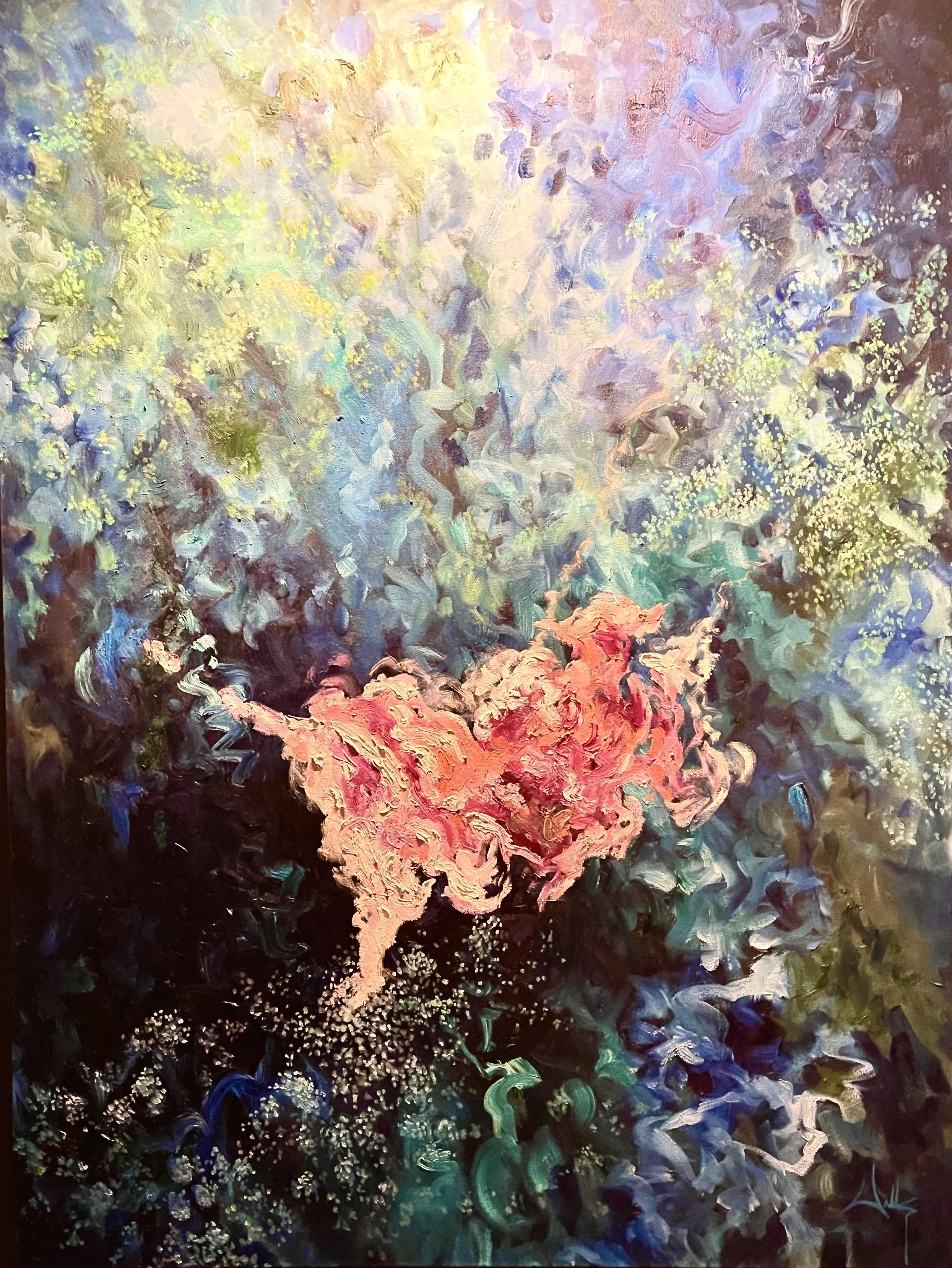
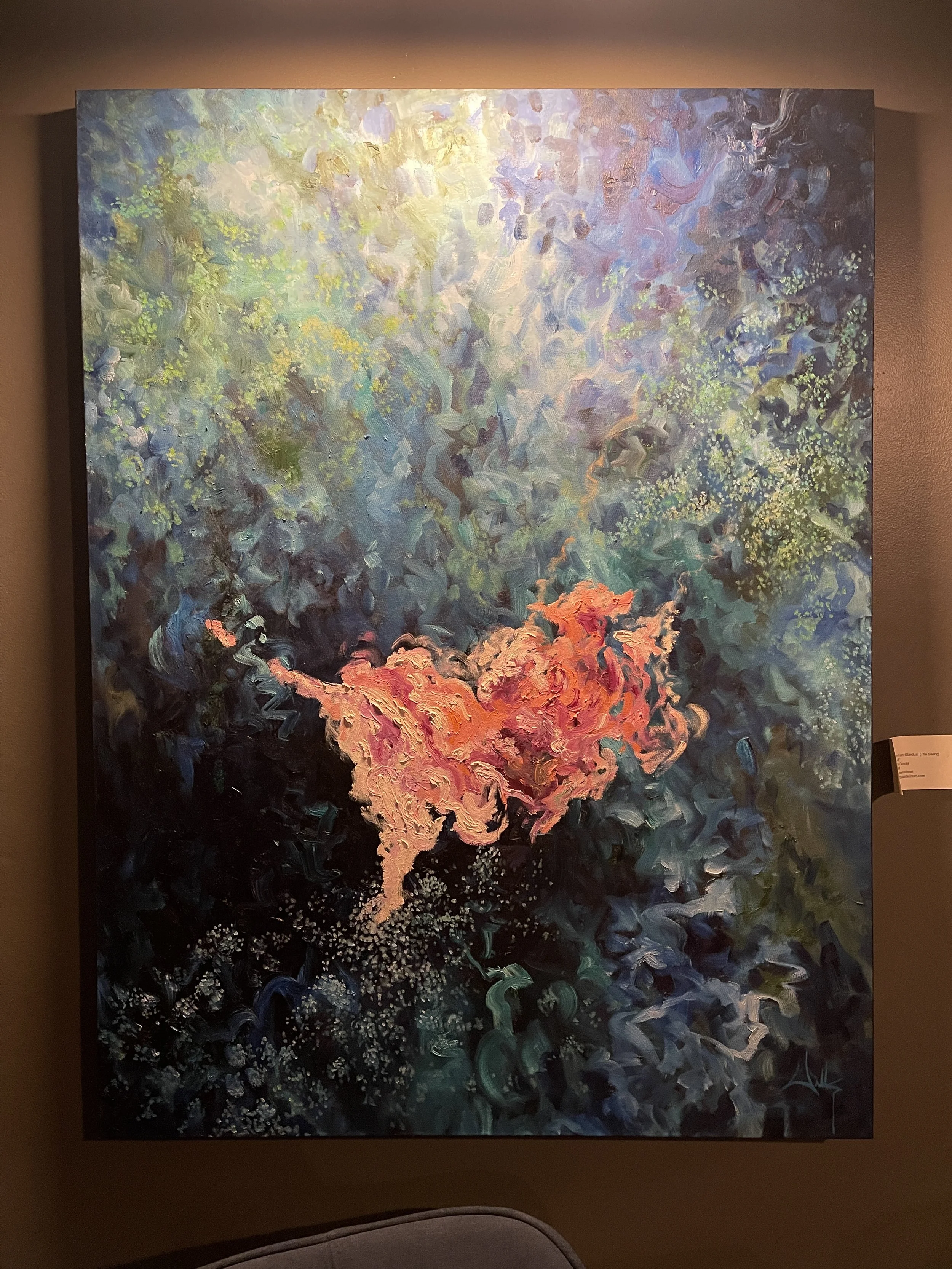
This painting reimagines “The Swing” by Jean- Honore Fragonard. This painting is not as a clear, narrative scene, but as something dissolving between memory, sensation, and reality.
At the center, the woman in the pink dress is no longer a sharply defined figure. Instead, she appears almost molten, her form breaking apart into thick, swirling strokes of coral, rose, and cream. The illusion of her body is unstable: at first glance, you can recognize the gesture of a reclining or drifting figure, but the longer you look, the more she seems to fragment into pure paint. Reality interrupts the illusion. Rather than a person on a swing, she becomes an impression of movement, a trace of presence rather than a fixed subject. It’s as if the act of swinging, motion, lightness, suspension, has overtaken her physical form and dissolved it into energy.
The “swing” itself is absent or obscured. There are no ropes, no clear structure anchoring her to the world. This omission pulls us further away from literal reality and into perception: what we’re seeing might be memory, or even a fleeting emotional state rather than an actual scene. The figure feels like she’s floating, untethered, as if gravity and context have been stripped away.
The background reinforces this shift. Instead of a recognizable garden, it becomes a luminous, abstract environment built from layered colors, cool blues, teals, and greens interwoven with bursts of yellow and lavender light. In some areas, the paint is soft and diffused, almost atmospheric; in others, it’s thick and textured, with visible, energetic brushwork. These contrasts mimic how the eye struggles to focus in motion: parts of the scene sharpen, while others blur into suggestion.
You can still “see” hints of foliage or light filtering through leaves, but they never fully resolve. The background behaves like vision itself, constantly adjusting, never fixed. Small specks and flecks of lighter paint resemble pollen, dust, or sunlight breaking apart in the air, adding to the sense that what we’re witnessing is not a stable environment but a sensory experience.
Ultimately, the painting alters the illusion of The Swing by shifting it from a staged moment of playful elegance into something more ephemeral and subjective. The woman in pink is no longer simply a figure in a garden; she becomes a fleeting apparition shaped by motion, light, and perception. Reality is not erased, but it is loosened, stretched until it hovers between what the eye sees and what the mind remembers.